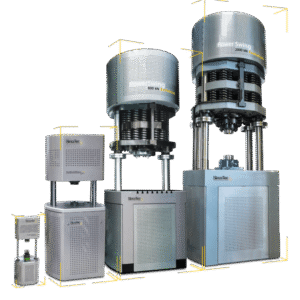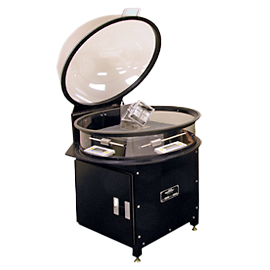
Raptor Scientific’ gimbal balancing machine series is the world’s only comprehensive set of machines for balancing gimbaled platforms. It combines both static balancing and dynamic balancing methods.
Many parameters influence the set of balancing instruments and methods needed to achieve the mission requirements. Depending on the application, Space Electronics will offer a set of static and dynamic balancing methods to achieve the best balance solutions for one particular gimbal.
Typical Applications
Our gimbal balancing solutions apply to all types of gimbals, with as many axes of rotation as desired. Typical applications include missile seekers, fast steering mirrors, missile jammers, and airborne cameras mounted on UAVs, helicopters, aircraft.
Gimbal Balancing Machine Specifications
The two primary factors affecting selection of a Space Electronics gimbal balance machine are weight of the gimbal and its unbalance tolerance.
Maximum gimbal weight. The machine must accommodate the maximum weight and size of the gimbals to be balanced. However, it should be no larger than necessary since large machines are more expensive and less sensitive than small machines.
Sensitivity to unbalance is defined by Space Electronics as the smallest unbalance moment that can be repeatably measured for a gimbal with a rotation angle of ±45 degrees. If the gimbal rotation angle is smaller than this, sensitivity of measurement will be reduced. The table below illustrates this effect.
You should select a gimbal balance machine which is at least 5 times more sensitive than the balance tolerance for the gimbal. To calculate the rated machine sensitivity (S) required when given a balance tolerance (G), use the following formula:
S = 1.4(G)(F)SIN(a)
where a is the maximum rotation angle of the gimbal (measured from the midpoint of rotation) and F is the ratio between machine sensitivity and gimbal balance tolerance requirement (typically 0.2).